

The most reliable mosquito protection for fishing is a repellent with a proven active ingredient (DEET or picaridin) on exposed skin, plus loose clothing with long sleeves. A hat with a neck flap and shoreside devices only add to this base. Ultrasonic bands and “folk” remedies have not shown consistent results in studies. Below is a comparison of all the methods by effectiveness, compatibility with tackle and comfort, with clear verdicts on what to choose for your situation.
Key takeaways
- The foundation is a repellent with a proven ingredient (DEET or picaridin) on exposed skin, plus loose clothing with long sleeves.
- Picaridin is safer for plastic, lacquer and synthetics than DEET, so it suits fishing tackle better.
- Ultrasonic bands and essential-oil bands have no proven effectiveness, so treat them only as an optional extra.
- A neck-flap hat covers only part of the body; at dawn and dusk near reeds you need repellent and covered clothing.
- Coils and vaporizers work in still air over a short distance, and choosing the right spot and time reduces the mosquito load.
- Choose by situation: picaridin for tackle handling, DEET for a proven all-rounder, a net for dusk in reeds.
Table of contents
Mosquito protection for fishing: a comparison table
Mosquitoes are most active at dawn and dusk, and they breed in standing water. Ponds, floodplains and reedy bays are exactly where we spend most of our time. Besides the annoying bites, mosquitoes can carry disease: Anopheles malaria mosquitoes are widespread in Ukraine, and cases of West Nile virus have been recorded in the south. The WHO advises combining repellents with clothing that covers the body.
The comparison criteria are simple: is there evidence it works, what exactly does the method cover, is it safe for tackle and glasses, how comfortable is it in the heat, and what does it cost. The table summarizes CDC, EPA and WHO recommendations; it is not the result of our own testing.
| Method | What it protects | Effectiveness | Main limitation | Verdict |
|---|---|---|---|---|
| DEET repellent (20–30%) | Exposed skin, outside of clothing | Proven, listed by CDC and EPA | Can damage plastic, lacquer, synthetics; needs reapplying | The base for most anglers |
| Picaridin repellent (about 20%) | Same | Proven, listed by CDC and EPA | Also needs reapplying; exact duration depends on the product | Most convenient around tackle |
| Loose clothing with long sleeves | Arms, legs, torso | Physical barrier | Hot; tight fabric doesn’t stop bites | Essential base |
| Neck-flap hat | Neck, ears, part of the face | Physical barrier, covers only part of the body | Doesn’t cover the front of the face or the hands | Good addition |
| Face net | Head and neck | High, if there are no gaps | Poorer visibility, awkward for casting and changing lures | For dusk and reeds |
| Permethrin-treated clothing | Fabric | Lasts through several washes | Never apply to skin; dangerous to cats and fish until dry | For frequent night trips |
| Coils, vaporizers | The area around your spot | Depends on wind and distance | Almost useless in wind; smell and smoke | For camping in calm weather |
| Ultrasonic band | Claimed: the person | No proven effectiveness | Reviews found no reduction in bites | Don’t rely on it |
| Essential-oil bands, folk remedies | Claimed: the person | Low in controlled trials | Don’t provide reliable protection | Don’t rely on them |
Repellents: what to choose and how to apply
Repellent is the only product that protects exposed skin even when mosquitoes are already circling you. Everything else either covers only part of the body or works only in certain conditions. So the choice and correct application affect the result more than any accessory.
DEET, picaridin or other ingredients
The CDC lists active ingredients with proven effectiveness that are registered with the EPA: DEET, picaridin (icaridin), IR3535, oil of lemon eucalyptus (OLE), PMD and 2-undecanone. On the packaging, look for the name of the ingredient and its percentage, not words like “natural” or “tropical effect.” The EPA advises choosing a repellent by its active ingredient and concentration; the CDC guidance collects all these ingredients in one place.
Concentration affects duration, not strength. For DEET, a higher percentage gives longer protection, but above roughly 50% the duration barely increases, as the EPA explains on its DEET page. For a few hours of fishing, products with 20–30% DEET or about 20% picaridin are usually enough. Check the packaging of the specific product for the exact duration.
For anglers there is one more argument. DEET can damage plastic, lacquer and synthetics, while picaridin, according to the EPA, does not damage plastic or synthetic fabrics. That means fishing line, crankbaits, soft plastic lures, glasses frames and rod handles. If you wear expensive polarized fishing glasses, picaridin is the safer choice.
Oil of lemon eucalyptus (OLE) and PMD are not recommended for children under 3 years old. For other age groups, pregnant women and people with skin reactions, read the instructions on the packaging carefully and ask a doctor if needed.
Application order and tips for anglers
Application rules are described in the EPA guidelines on using repellents safely. I’ll add a few tips that matter specifically near the water.
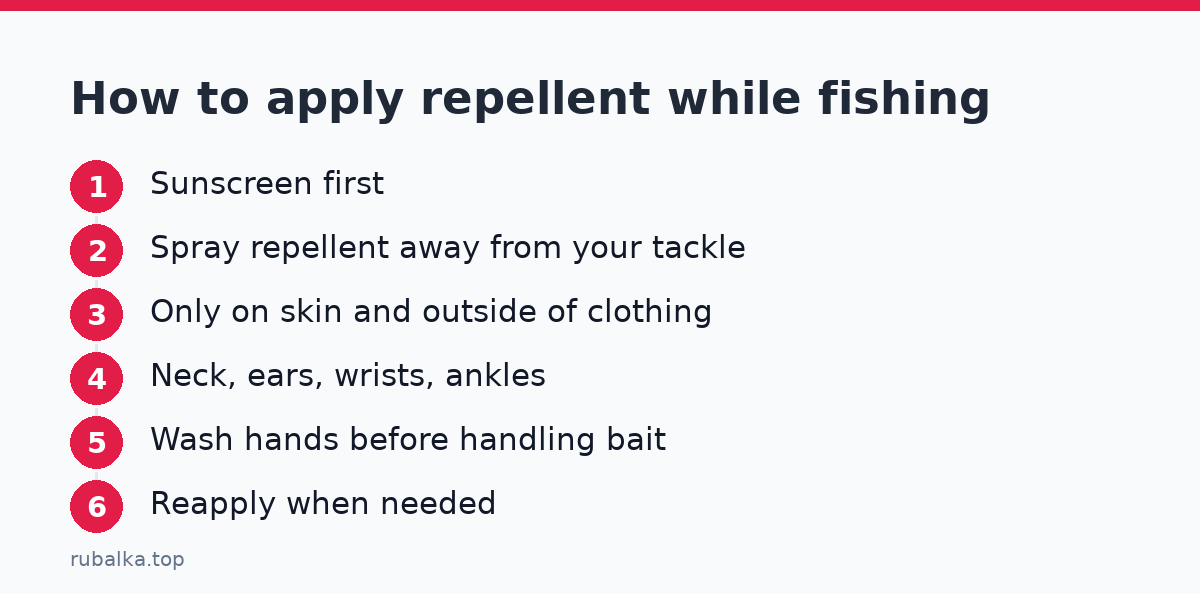
- Apply sunscreen first and let it absorb. Repellent goes on top of it.
- Spray repellent outdoors, away from lure boxes, reels, rods and glasses. Apply it to the face through your palms, without touching your eyes or lips.
- Apply only to exposed skin and the outside of clothing. Never apply under clothing or on wounds or irritated skin.
- Don’t skip the neck, ears, wrists, ankles and the strip between your T-shirt and trousers. That’s where mosquitoes bite most often.
- Before handling bait, lures or food, wash your hands thoroughly with soap. That way you won’t carry the smell of repellent onto the hook or get it into your mouth.
- Reapply after heavy sweating, swimming, or when mosquitoes start landing on your skin again, and in the evening, rather than waiting for peak activity.
Spray repellent on an area you won’t touch with tackle afterward, and let it dry for a minute or two before picking up the rod. That leaves less of the substance on the handle and lures.
One caveat: mosquito repellent does not guarantee protection against ticks. For those you need separate products, the appropriate labeling on the packaging, and a check of your clothes and body after the trip.
Clothing, neck-flap hats and face nets
A physical barrier doesn’t depend on concentration, wind or duration of action. Its weak points are heat and discomfort. That’s why it’s important to understand what exactly it covers.
Clothing: loose, long and light-colored
The CDC advises wearing long sleeves and trousers. Loose clothing works best, because mosquitoes bite through tight fabric, especially at the elbows, knees and back when you lean forward. For a hot summer, choose light, quick-drying fabric: it irritates less than a heavy one. Remember that covered clothing doesn’t protect your hands and face, so you still need repellent.
Neck-flap hat
A hat with a protective strip at the back covers the neck and ears: the typical bite spot when you are watching a float or a rod tip. It reduces the load but doesn’t solve the problem completely: the front of the face, the nose, hands and ankles remain exposed.
If you are looking for this kind of option, the store has a fishing hat with a visor and neck protection. It is light, dries quickly, has an adjustable circumference of 54–60 cm and costs UAH 250. The manufacturer describes the mesh inserts as ventilation, so don’t expect them to replace a mosquito net. The hat works well as sun protection and partly against mosquitoes, but not as the only measure.
For dusk and thick reeds there is also a mosquito net that goes over the hat. It is very effective as long as there are no gaps, but it reduces visibility and gets in the way of casting and changing lures. So it is used on night camps, not during active spinning.
Permethrin for clothing: when it’s worth it and when it isn’t
The CDC notes that clothing and gear (shoes, tents, fishing suits) can be treated with permethrin, and the effect lasts through several washes. Permethrin must never be applied directly to skin. Treat items at home, outdoors, and let them dry completely before wearing. Also keep treated and damp items away from cats, and don’t rinse them in a body of water: permethrin is toxic to fish. This is an option for those who often go night fishing and camping; for one-off trips, repellent and loose clothing are enough.
Ultrasonic bands and “magic” remedies: the honest limits
Ultrasonic mosquito repellers have no proven effectiveness. Reviews of studies did not find that they reduce the number of bites. Essential-oil bands showed low effectiveness in controlled trials, and one study concluded that they do not provide reliable protection. In other words, the main problem is that, according to current data, such devices don’t give a guaranteed result, especially in the evening when mosquitoes are at their worst.
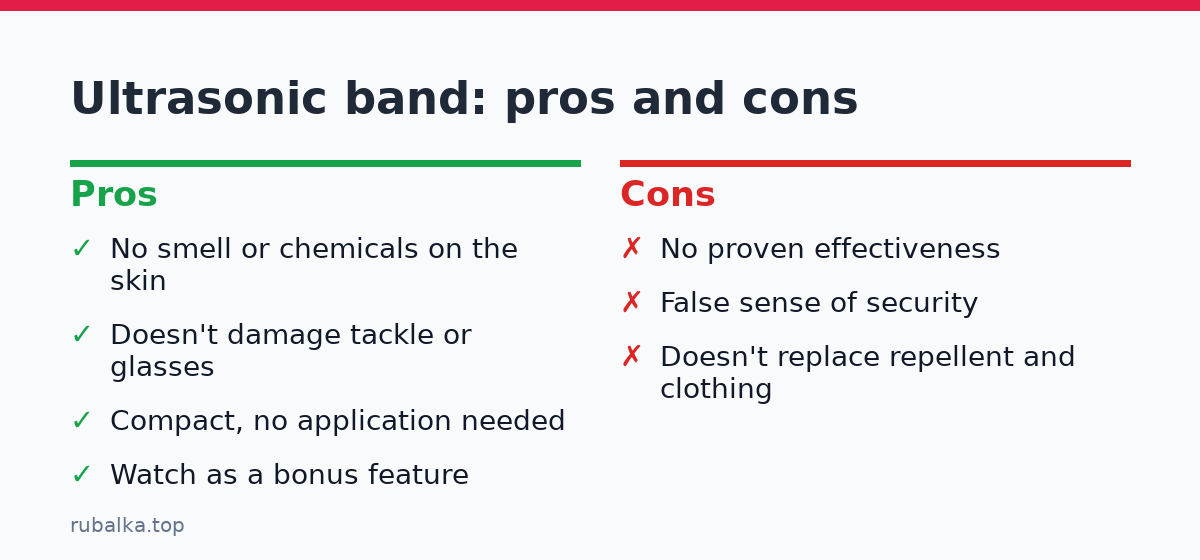
That doesn’t mean a band is pointless in every respect: it has no smell, doesn’t damage tackle and doesn’t need to be applied. The store has ultrasonic bands with a watch, for example a white one for UAH 400. If you want to try one, treat it as an extra gadget, not as your main protection.
The biggest risk of a band is a false sense of security. If you head to a reedy bay in the evening with only a band, without repellent and covered clothing, the consequences are easy to predict.
The same applies to folk remedies: essential oils on the skin, garlic, wormwood, stickers and vitamin B1. There is no reliable evidence that they work, so don’t build your protection on them, especially in areas with disease-carrying mosquitoes. A self-check: if mosquitoes still land on you after 10–15 minutes, the method isn’t working.
On-site measures: coils, vaporizers, smoke and choosing your spot
Coils, electric vaporizers and thermacell-type devices create a cloud of active substance around your spot. They work best in still air, within a radius of a few meters. Wind quickly disperses the effect, and you end up unprotected. For a night camp with a tent or near a bivouac, they are a good addition to repellent, but not a replacement.
Campfire smoke also repels some mosquitoes, but sitting in smoke for that purpose is unpleasant, and a fire near the water is not always allowed or appropriate. The smell of a coil and smoke can spoil the trip for you and for the anglers next to you. Keep them on the downwind side of you, not right under your nose.
Choosing your spot and time reduces the problem without any products:
- Stand on an open bank with a breeze, away from thick reeds and stagnant bays. Even a slight draft noticeably reduces the number of mosquitoes.
- Mosquitoes are more active at dawn and dusk, so strengthen your protection in those hours: repellent, covered arms and neck.
- There are usually fewer mosquitoes from a boat than on a reedy shore. For preparation, read the article on fishing from a boat.
- When planning a trip, also take the weather into account: the article on weather for crucian carp fishing covers the conditions in which fish are more active, and a windy day is often more comfortable for you too.
If you fish for crucian carp in the daytime on a pond, also see the article on summer crucian carp fishing: it covers methods that let you pick a more comfortable time.
What to choose: verdicts by situation
There is no single perfect method, so good protection is a combination. Below is a short cheat sheet depending on how and where you fish.
- Choose picaridin if you often handle lures, crankbaits and glasses and don’t want to risk plastic and lacquer.
- Choose DEET (20–30%) if you need a proven all-round product and are ready to apply it carefully, away from tackle.
- Choose loose clothing with long sleeves if you fish in the evenings or at dawn near standing water. This is the base without which repellent can’t cope on its own.
- Choose a neck-flap hat if you spend most of your time in the sun and want to cover your neck and ears. Repellent on the face and hands is still a must.
- Choose a face net if you are camping overnight in reeds or near a bay with a great many mosquitoes.
- Choose permethrin-treated clothing if you go on multi-day trips and are ready to treat items in advance, at home.
- Choose a coil or vaporizer if you sit in one place in calm weather, for example by a tent or table.
- Take an ultrasonic band only if you are simply curious to try it, and only together with repellent and clothing.
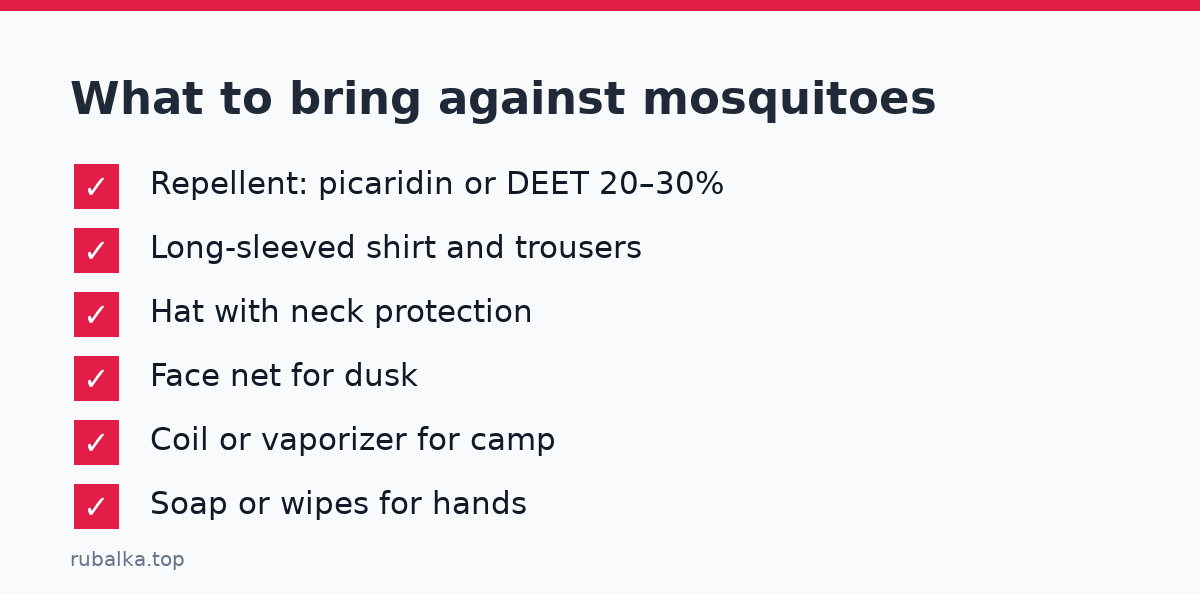
A good minimum for a trip: repellent (picaridin or DEET), a light long-sleeved shirt, a neck-flap hat, and soap or wipes for washing your hands before handling bait. For a night camp, add a net and a coil. If after bites you develop severe swelling, a high temperature or other worrying signs, see a doctor.
FAQ
What is the best repellent for fishing near water?
Choose a product with a proven ingredient: DEET (20–30%) or picaridin (about 20%). Picaridin is more convenient around tackle because it doesn't damage plastic or synthetics. Apply repellent to exposed skin and the outside of clothing, and wash your hands before handling bait.
Do ultrasonic mosquito bands work?
Ultrasonic repellers have no proven effectiveness: reviews of studies found no reduction in the number of bites. Essential-oil bands also showed low results in controlled trials. Treat them only as an optional extra on top of repellent and covered clothing.
Does DEET damage tackle and glasses?
Yes, DEET can damage plastic, lacquer and synthetics, meaning glasses frames, lures and handles. Picaridin, according to the EPA, doesn't cause such damage. Either way, spray repellent away from your gear and don't get it on lures.
Are repellents safe for children?
Oil of lemon eucalyptus (OLE) and PMD are not recommended for children under 3 years old. For other age groups, choose a product according to the instructions on the packaging and don't apply it to wounds or irritated skin. For pregnant women and those with skin reactions, it's best to consult a doctor.
When are mosquitoes most active and where is it best to stand?
Mosquitoes are most numerous at dawn and dusk, especially near standing water, floodplains and reedy bays. It's best to stand on an open bank with a breeze, away from dense thickets. There are usually fewer mosquitoes from a boat than near reeds.




Leave a Comment
Your email address will not be published. Required fields are marked *