

Fall pike fishing with a spinning rod comes down to three decisions: what depth the fish are holding at, which lure works in that water, and what retrieve to use with it. Below you will find a step-by-step guide with a check after each step, a “water conditions → lure → retrieve” table and a breakdown of common mistakes. I take the numbers from open sources, and where there are none, I give you a way to check rather than an invented figure.
Key takeaways
- Depth shifts by month: in September, look at water up to 1.5–2 m deep along the edges of clear water and vegetation; in October, 4 m and deeper; in November, 3–5 m for big crankbaits.
- Spinnerbaits work best early in the fall, before October; later, jigs, sinking plugs and heavy soft plastics take over.
- Always use a leader: pike teeth damage both braid and thin mono, so braid stays as the main line and the leader protects against bite-offs.
- In fall the retrieve slows down: a stop-and-go retrieve along the bottom for a jig, and long pauses of 5–8 seconds for a crankbait.
- The pike closed season in Ukraine runs from February 15 to March 31, but in fall the size limits and quotas in the amateur fishing rules still apply, so check the current version.
Contents
Where and when pike hold in fall: month, temperature, depth
Sources describe September as the start of the second feeding peak for pike. When the water cools to roughly 17 °C at night, pike feed actively throughout the daylight hours. At this time, the best spots are areas up to 1.5–2 m deep along the edges of clear water and vegetation.

In October the aquatic vegetation dies back, and pike follow the baitfish out to depths of 4 m and more. That is why anglers are advised to work the first drop-off near the shore, where the depth falls sharply from 1–1.5 m to 4–5 m. According to the calendar in the sources, in October pike become more active closer to midday, roughly from 11:00 a.m. to 4:00 p.m., and the best fish often bite on an overcast, drizzly day.
In November, big crankbaits that dive to 3–5 m and heavy soft plastics work well. The retrieve is slow. The sources give no specific temperature thresholds below 17 °C, so don’t fixate on the number on the thermometer. Go by depth, by how the fish respond, and by whether you get bites on a slow retrieve near the bottom. For more on how water temperature changes fish behavior in general, see the article on the role of water temperature in fishing.
The sources contradict each other on depth: some put pike at 1–3 m, others at 4 m and deeper. The contradiction is only apparent, because the answer depends on the month, whether the vegetation is still alive, and the profile of the water body. So the plan is this: start with the zone that matches the month, then check neighboring depths rather than arguing with the sources.
Tackle for fall pike: rod, braid, leader
For fall fishing, spinning rods 2.4–2.7 m long with a 10–30 g casting weight are recommended. That length allows long casts, and the rating lets you feel the lure during a jigging retrieve. For long casts in October and November, a rod of about 270 cm with a fast action is advised. For more on rod classes, see the article on types of spinning rods for pike and perch.
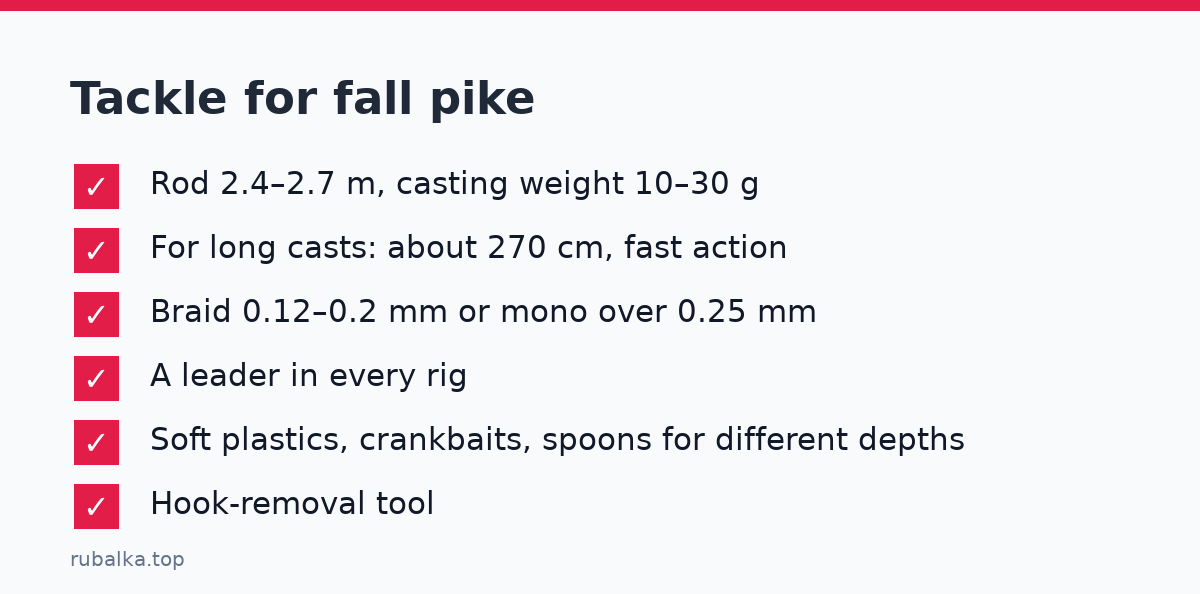
For the main line, the sources recommend braid of 0.12–0.2 mm or monofilament thicker than 0.25 mm. Braid transmits the lure touching bottom and light bites well, which matters with a stop-and-go retrieve. How to choose diameter and weave is covered in the article on fishing braid.
A leader is always needed, because pike teeth are sharp and fray both braid and thin mono. Without one, the first serious strike can end in a bite-off and a lost lure. Leader material is a separate decision, and the sources give no single answer. The general logic is this: fluorocarbon is less visible, but a pike can chew through a thin leader; wire is more resistant to teeth, but it can affect the action of a light lure. This is reasoning, not test results, so pick the option that suits your water and your lure.
Don’t tie the lure straight to the braid, even if pike “won’t take it on a leader.” A bite-off leaves the fish with a hook and a piece of line, and leaves you with a lost lure.
Fall pike fishing with a spinning rod: seven steps with checks
Below is the order of actions from choosing a spot to recording the result. After each step there is a “Check” point: if the answer is no, don’t move on, fix it first.
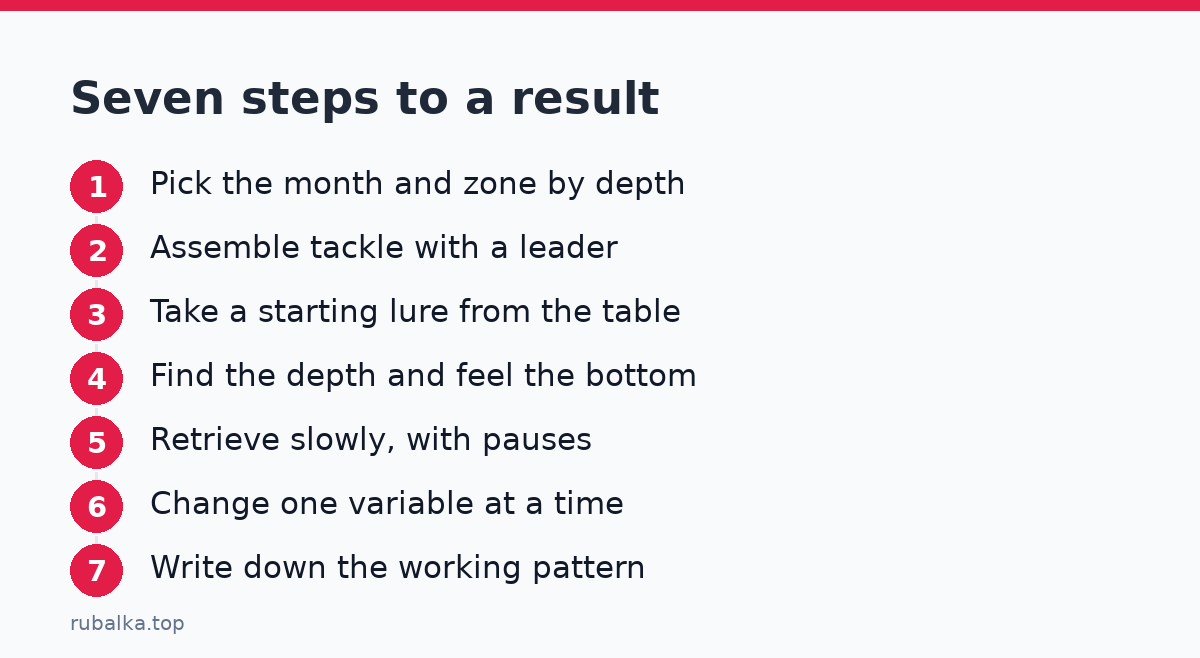
- Pick the month and the first zone. September: up to 1.5–2 m along the edges of clear water and vegetation; October: the first drop-off near the shore, going down to 4–5 m; November: depths of 3–5 m. Check: does the chosen zone have a change in depth or a vegetation edge, rather than being a flat area?
- Assemble your tackle. Rod 2.4–2.7 m, casting weight 10–30 g, braid 0.12–0.2 mm, leader. Check: does the rod’s rating match the weight of the lure, is the braid free of abrasions, and is the knot on the leader secure?
- Choose a starting lure from the table below. Early in the fall, a spinnerbait; in October, a vibrating soft-plastic tail, twister or spoon; in November, a big crankbait or heavy soft plastic. Check: does the lure suit the depth and clarity of the water?
- Find the depth and feel the bottom. Cast a jig lure and let it fall until the line goes slack, count the seconds of the fall, then repeat at another spot. For a crankbait, find its diving depth from the manufacturer’s specifications. Check: do you feel contact with the bottom on a stop-and-go retrieve, and is the lure not dragging through silt unnoticed?
- Retrieve slowly. For a jig, stop-and-go near the bottom; for a crankbait, long pauses of up to 5–8 seconds. Check: is there at least one pause during which the lure hangs or sits motionless?
- Change one variable at a time. First the depth or spot, then the lure, then the pace. Check: can you say exactly what you changed after each fruitless series of casts?
- Lock in the result. If you had a bite or even a tap, write down the depth, lure and retrieve, and fish the same structure from a different angle. Check: do you have a tool at hand for releasing the fish safely?
A fish finder helps locate depths and bottom changes on an unfamiliar water body. How it works and what to consider when choosing one is covered in the article on choosing a fish finder.
Table: water conditions → lure → retrieve
The table is compiled from the recommendations in the sources. It is a starting point, not a guarantee of a catch: if 15–20 casts at a promising spot produce nothing, change the depth first, then the lure.
| Conditions | Lure | Retrieve |
|---|---|---|
| Early fall, shallows up to 1.5–2 m along the edges of clear water and vegetation | Spinnerbait (best before October) | Steady, searching |
| Depth 1–4 m, summer and fall | Crankbait | Steady |
| Actively searching for pike in the shallows | Twitching lures | Twitching |
| October, first drop-off near the shore, depth 4–5 m | Vibrating soft-plastic tail, twister, spoon | Stop-and-go near the bottom, imitating a wounded fish |
| Murky water or a bottom of unknown contour | Soft plastic on a jig head | Stop-and-go along the bottom |
| Depth 3–10 m | Soft plastic on a jig head | Stop-and-go along the bottom |
| Great depth, retrieve along the bottom | Sinking plug | Stop-and-go |
| November, depth 3–5 m | Big crankbait diving to 3–5 m; heavy soft plastic | Slow, with long pauses of up to 5–8 s |
| Snaggy water | Slug or soft-plastic worm | Slow, keeping snags under control |
The stop-and-go retrieve: the core of October
The principle is simple: the lure rises off the bottom, then falls, and you take up the slack again. The fall is the most important phase, because that is when pike usually grab the “wounded” fry. Don’t rush the next lift: let the lure touch bottom and watch the line, which at that moment will go slack or twitch.
The strength and height of the lift depend on the depth, the weight of the jig head and the mood of the fish. There is no universal figure, so work it out on the spot: if the lure jumps up jerkily and drops fast, reduce the amplitude; if you can’t feel the bottom, increase the jig head weight or shorten the lift. For soft plastics, a good start is a jig head heavy enough to let you feel the bottom at your depth, and no heavier.
If you are looking for lures to start with, take a look at the soft-plastic swimbaits in the store. For example, a set with different colors in one pack and a size of 100 mm is handy for comparing colors in murky water and for trial retrieves. This is only one possible option, not a required choice.
Slow retrieves with pauses for a crankbait
In November a crankbait is retrieved slowly and with pauses. The sources recommend long pauses of up to 5–8 seconds, because pike often attack a lure that is hanging in the water column. Wind in a few turns of the reel, pause, then a few more turns, and pause again.
Count the pause to yourself rather than going by eye: in cold fall weather it feels shorter than it really is. If the crankbait runs without twitches after a pause and the pike hasn’t come, lengthen the pause rather than speed up. For a depth of 3–5 m, take a crankbait whose rated diving depth matches those figures rather than merely approaching them.
Steady retrieve and twitching
The sources link the steady retrieve with crankbaits at a depth of 1–4 m and with spinnerbaits in early fall. Twitching is recommended for actively searching for pike and perch in the shallows, and jigging for trophy fish and great depths. So there is no point carrying twitching over to the deep zones of October and November just because it is “fashionable.”
For comparing lures for perch and the general logic of choosing them, it is worth reading the article on effective lures for perch fishing: many principles about size and color overlap.
Common mistakes, with examples
Below are model scenarios built from the advice in the sources, not reports of specific trips. They show what a mistake looks like and how to fix it.
- October, fishing along the reeds in the shallows. The angler fishes spinnerbaits at 1–1.5 m and gets no bites. Cause: the vegetation has died back, and the pike have most likely moved to a depth of 4 m and more. Fix: move to the first drop-off near the shore and use a jig lure with a stop-and-go retrieve.
- November, a crankbait on a steady retrieve. The lure runs fast and without pauses. Fix: slow down, add pauses of up to 5–8 seconds, and switch to a crankbait that dives to 3–5 m.
- Snaggy water and ordinary soft plastic on an open jig head. Snags take one lure after another. Fix: use a slug or a soft-plastic worm, as the sources advise, and retrieve slowly.
- Thin braid without a leader. The very first bite ends in a bite-off. Fix: a leader in every rig.
- Fishing only in the morning. The angler catches nothing early in the morning and leaves the water. For October the sources give activity at roughly 11:00 a.m. to 4:00 p.m., so don’t give up on a spot until you have checked that window, especially on an overcast day.
Going out in a boat changes your approach to depths and safety; more on this in the article on fishing from a boat.
Rules, safety and releasing pike
In Ukraine, the ban on catching pike runs from February 15 to March 31 inclusive on all fishery water bodies, as reported by the State Fisheries Agency on the Cabinet of Ministers portal. A pike caught accidentally during this period must be released. There is no such spawning ban on pike in fall, but the size limits and quotas in the amateur fishing rules still apply, and you should check them in the current version of the document and for the specific water body before you go.
If you plan to release the pike, get your tools ready in advance. Hold the fish with wet hands, don’t drag it onto dry gravel, and don’t drag out the photo session. Remove the hook from the mouth with a tool, not your fingers, because pike teeth are sharp. For simple jobs, a hook extractor will do.
It is a simple hook-removal tool that combines three functions, but for a big pike with a deeply swallowed hook, it is better to have separate long-nose pliers. For more advice on choosing lures and retrieve styles, see the fall pike calendar on fishmap and the article on fall pike fishing with a spinning rod.
A practical summary for your next trip: pick the month and the zone by depth, use a leader, start with a slow retrieve near the bottom, and change one variable at a time. Write down the depth, lure and pause after every bite so that next time you can start with a working pattern.
FAQ
When do pike bite best in fall: September, October or November?
Sources describe September as the start of the second feeding peak, when pike feed actively throughout daylight. In October, activity shifts closer to midday, roughly 11:00 a.m. to 4:00 p.m., especially in overcast drizzle. In November, slow retrieves at a depth of 3–5 m work. Which month is best depends on the water body and the weather.
What depth do pike hold at in fall?
In September, areas up to 1.5–2 m deep along the edges of clear water and vegetation are recommended. In October the vegetation dies back and pike move out to 4 m and deeper, so anglers work the first drop-off near the shore, going from 1–1.5 m down to 4–5 m. In November, crankbaits that dive to 3–5 m work well.
Which lure should I choose for pike in October and November?
In October, jig lures come to the fore: vibrating soft-plastic tails, twisters and spoons, fished stop-and-go near the bottom. In November, big crankbaits that dive to 3–5 m and heavy soft plastics on a slow retrieve work well. Spinnerbaits are better used early in the fall, before October.
Do I need a leader if my line is braid?
Yes, a leader is always needed. Pike teeth are sharp and damage both braid and thin mono, so without a leader the risk of a bite-off is high. Braid is recommended as the main line for its sensitivity, while the leader protects against the teeth.
Is there a closed season on pike in fall?
The pike closed season runs from February 15 to March 31 inclusive, so there is none in fall. But the size limits and quotas in the amateur fishing rules still apply. Check the current requirements for your water body before you go.

Leave a Comment
Your email address will not be published. Required fields are marked *