

The simplest homemade crucian carp groundbait is a porridge of millet, semolina and pearl barley, with sunflower meal and breadcrumbs added at the end. For summer heat there is a dry, fine-grained mix of breadcrumbs, cornmeal, ground seeds and bran, and for the spring-type (“pruzhyna”) rig there is a pea and millet porridge with nuts. Below are five recipes with proportions, a comparison table and adjustments for spring and summer.
A note on sources: the recipes are collected from publicly available fishing material, and the proportions come from there. We did not cook these mixes and test them on the water, and we don’t promise a catch, so try a small batch and adjust it to your own water. Our own additions in the text are marked with the words “our tip”.
Key takeaways
- The basic option is a porridge of millet, semolina and pearl barley, with sunflower meal and breadcrumbs added at the end.
- A ball should hold together in your hand and break apart when it hits the water; don't overcook the millet unless the mix is for a feeder.
- In spring crucian carp become active at 10–12 °C, and plant-based boilies and dough make sense after 14–15 °C; in summer you need a fine, not too rich mix with a light scent.
- Add oilseed meal or oilcake right before feeding, because a ready mix turns sour quickly.
- Overfeeding stops the bite: start with a small initial feed and add a little at a time.
Contents
What groundbait texture works in still water
The sources don’t split recipes into “for still water” and “for running water”, so what follows is what they say about texture, plus our conclusion. In a pond or lake there is no current to spread the mix, and the ball stays where it landed. So it should be neither a rock nor a powder that scatters in the air.

What the sources say about groundbait structure:
- dry fractions (barley and corn grits) are added to hot porridge after the water has evaporated, so the mix stays crumbly;
- the dry millet and oilcake version is described as binding well and breaking apart when it hits the water;
- if the groundbait is not for a feeder, the millet is not overcooked;
- potatoes with oilcake are mashed to lumps, not to a puree;
- a summer mix should be fine-grained, not too rich and lightly scented.
For millet, one source gives a guideline: about 5 L of water per 1 kg of grain and 15–20 minutes, until the grains open up.
Our tip (not in the sources): before you leave, shape a ball from a handful of the mix and drop it on the ground or into a bucket of water. If the ball doesn’t hold its shape, add dry components such as breadcrumbs; if it falls apart in your hand, add a little water.
Homemade crucian carp groundbait: 5 recipes with proportions
Each recipe lists the ingredients, the method, why you might choose it, who it suits and its downside. “Cup” in the sources means an ordinary household glass; the exact volume is not specified.

Recipe 1. Three-grain porridge, sunflower meal and breadcrumbs
Ingredients from the natural groundbait recipe from Telegraf: millet 400–500 g, semolina 200 g, pearl barley 200 g, a cup of sunflower meal, a cup of breadcrumbs.
Method: boil the grains for about 30 minutes, stirring constantly so they don’t burn. Drain the water so it covers the mix by no more than 1 cm. Let the porridge cool and only then add the meal and breadcrumbs.
- Why choose it: the ingredients are simple, three ordinary grains and two dry additives, with no complicated steps.
- Who it suits: a beginner who wants a basic homemade porridge, and anyone who prepares groundbait the day before a trip.
- Downside: about half an hour at the stove with constant stirring; the recipe has no flavouring, so add your own if needed.
Recipe 2. Crumbly porridge with corn grits, vanillin and oil
Ingredients from the working porridge recipe on fishingukr.com: 3 cups of water, a cup each of pearl barley and millet (or wheat groats), 0.5 cup of barley grits, 1–2 cups of coarse corn grits, 2 sachets of vanillin, 1–2 tablespoons of unrefined sunflower oil.
Method: boil the pearl barley and millet in water. Add the barley and corn grits to the hot porridge after the water has boiled off, so the mix stays crumbly. The source doesn’t give a cooking time, so go by how done the grains are.
- Why choose it: crumbly texture and flavouring are written straight into the recipe; the oil is unrefined.
- Who it suits: anyone who wants an aromatic, crumbly base without store-bought additives.
- Downside: four kinds of grain, so buying and measuring are harder than in the first recipe; the source doesn’t describe the exact order for adding vanillin and oil.
Recipe 3. Peas and millet with nuts for the spring rig
Ingredients from the description on naturespace.com.ua (the author calls it feed for big crucian carp and bream on the spring-type rig): 1 cup of split yellow peas, 1 L of water, 2 crushed walnuts, 0.5–1 cup of millet, 0.5 cup of roasted oilcake, 1 cup of semolina.
Method: boil the peas with the nuts for 25–30 minutes, then add the millet and boil for another 10 minutes. At the end, stir in the roasted oilcake and semolina.
- Why choose it: this is the only recipe in the selection that its author explicitly intends for fishing with a spring-type rig; it contains peas, one of the plant components other sources recommend for summer.
- Who it suits: anglers using the spring-type rig who want something more than plain porridge, with peas and nuts.
- Downside: the longest recipe, about 40 minutes of cooking; the oilcake must be roasted in advance, and the source doesn’t explain how.
Recipe 4. Potatoes with oilcake
Ingredients from the material on uralfish.ru: about 7 small potatoes for a three-hour session, oilcake, a little water.
Method: boil the potatoes without salt so they stay whole. Then add the oilcake and mash to lumps (not to a puree), and pour in a small amount of water so the mass swells and thickens.
- Why choose it: the base is ordinary potatoes, no grains needed, and the “7 potatoes for three hours” figure gives at least some sense of quantity.
- Who it suits: anglers going out for a few hours who don’t want to cook several grains.
- Downside: the source doesn’t give the amount of oilcake, so you judge the proportion by eye; oilcake is the main component of this mix, so prepare it right before feeding.
Recipe 5. Dry summer mix, no cooking
Ingredients from the material on summer crucian carp fishing on fishingukr.com: 50% breadcrumbs, 20% cornmeal, 20% ground roasted seeds, 10% bran. The source doesn’t say whether the percentages are by weight or by volume.
Method: mix the components dry. Our tip (not in the source): measure by volume with a single container, 5 scoops of breadcrumbs, 2 of cornmeal, 2 of seeds, 1 of bran. To make balls, moisten with a spoonful of water from the pond at a time and check whether the ball holds its shape.
Feeding according to this material: start with 2–3 balls the size of a tangerine, then one small ball at a time.
- Why choose it: this is the same fine-grained, not too rich mix the author recommends for summer; there is nothing to cook.
- Who it suits: summer anglers who don’t want to spend time at the stove.
- Downside: you have to roast and grind the seeds yourself or find them ready-made, and you have to work out the exact measures on your own.
Comparing the recipes and choosing yours
The table is compiled from the sources’ data, not from our own testing.
| Recipe | Base | Preparation | Added at the end |
|---|---|---|---|
| 1. Three grains | millet, semolina, pearl barley | boil about 30 min, cool | sunflower meal and breadcrumbs |
| 2. Corn grits porridge | pearl barley, millet, barley and corn grits | cook the porridge, add dry grits after the water boils off | vanillin and unrefined oil |
| 3. Peas and millet for the spring-type rig | yellow peas, millet, nuts | peas 25–30 min, millet another 10 min | roasted oilcake and semolina |
| 4. Potatoes with oilcake | potatoes, oilcake | boil potatoes without salt, mash | a little water until it swells |
| 5. Dry summer mix | breadcrumbs, cornmeal, seeds, bran | dry mixing, no cooking | water for the balls (our tip) |
How to choose quickly:
- no time at the stove: recipe 5, or recipe 4, where you only boil potatoes;
- fishing with the spring-type rig: recipe 3;
- you need a crumbly, aromatic base: recipe 2;
- your first homemade groundbait: recipe 1.
The sources also contain other options. A dry mix: 2 cups of millet and 2 cups of oilcake, which binds well and breaks apart when it hits the water; the source doesn’t say what form the millet should be in, so test a small batch. A corn porridge: 2 cups of boiled pearl barley (or wheat), 1 cup of boiled corn, a cup each of semolina, breadcrumbs and sunflower meal, with garlic as a flavouring. A “grandfather’s” version: 2 cups of boiled millet, burnt crusts of black bread and unrefined oil. There is also a blend of homemade and store-bought groundbait: semolina, pearl barley, millet, breadcrumbs and 2 cups of store-bought flavoured groundbait.
Spring and summer: what to change in your groundbait
Choose the mix to suit the water temperature. In spring crucian carp become active when the water reaches 10–12 °C, while plant-based boilies and dough become relevant later, after 14–15 °C. For more on when the bite starts, see the article on spring crucian carp fishing and the material on the role of water temperature.
| Parameter | Spring | Summer |
|---|---|---|
| Water | activity from 10–12 °C | optimum +18…+23 °C |
| Food in the water | little plant food yet | plenty of plant food |
| Mix | porridges (recipes 1, 2); after 14–15 °C add plant components, such as peas (recipe 3) | fine-grained, not too rich mix with a light scent (recipe 5); plant components: wheat, peas, oilcake, semolina, cornmeal |
| Feeding | no norms in the sources, start with small portions (our tip) | start with 2–3 balls, then one small ball at a time |
The row on spring mixes is our conclusion from the temperatures: the sources don’t give a separate spring recipe. The summer data match the advice on summer crucian carp fishing and, for more methods and techniques, our article on summer crucian carp fishing.
Don’t overfeed the fish: too much groundbait can stop the bite. In summer this is especially noticeable, because the mix should not be filling.
The sources we studied have no separate mixes for autumn, so we give no advice here. See our material on autumn crucian carp fishing.
Feeding, storage and common mistakes
The order of actions at the water, drawn from the sources described above:
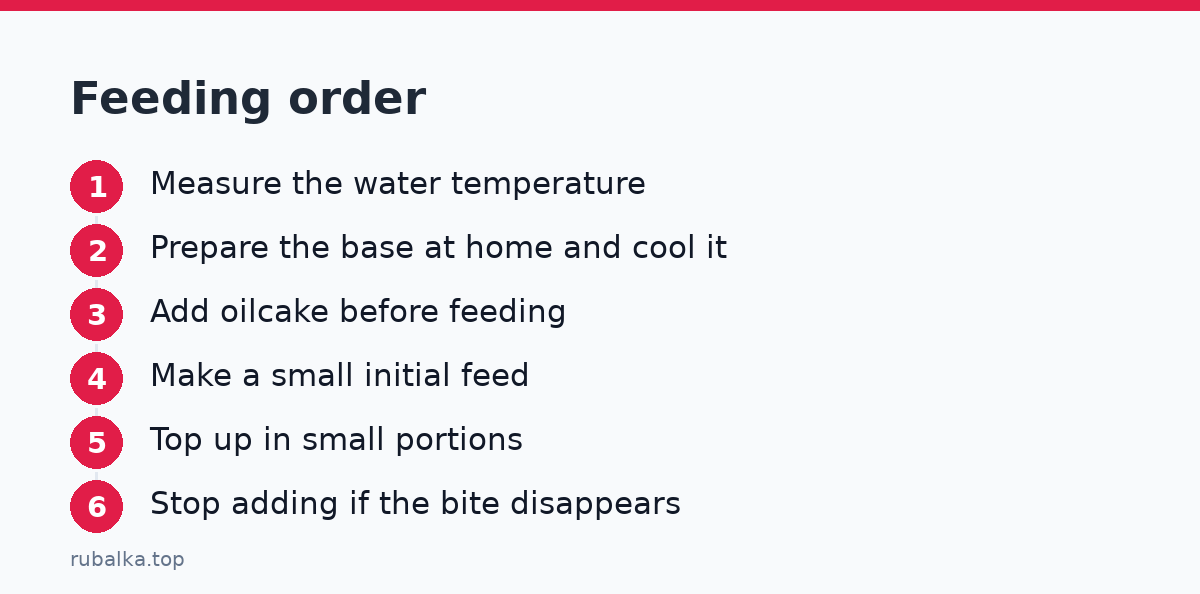
- Find out the water temperature, which tells you which mix to use, spring or summer.
- Prepare the base (porridges or the dry mix) at home and cool it.
- Stir in the sunflower meal or oilcake on the bank right before feeding.
- Make the initial feed: in the summer material, 2–3 balls the size of a tangerine.
- After that, feed in small portions and watch the bite.
- If the bite stops, stop adding groundbait: you may have overfed the fish.
A ready mix with sunflower meal or oilcake turns sour quickly, so don’t prepare it in advance and don’t carry it around for several days. The sources don’t say how long a dry base without oilcake keeps, so make it for a single trip.
One tip is to scatter simple mixes (breadcrumbs, cornmeal, flavourings) about an hour before fishing. The sources give no exact amount of groundbait for a whole session: what is known is 7 potatoes for three hours (recipe 4) and a summer feed of a few balls.
Common mistakes that follow from the recipes:
- overcooked millet when the groundbait is not for a feeder;
- salt in the potatoes for recipe 4: they are boiled without salt;
- a mix that is too rich or too strongly scented in summer, when a light scent is needed;
- adding oilcake in advance;
- a big feed all at once instead of gradual feeding.
Where to start on your next trip
Take recipe 1 and cook it the day before, then add the sunflower meal and breadcrumbs on the bank. In summer, or when you’re short on time, dry mix no. 5 will do instead. Feed the groundbait to your float tackle; the article on catching crucian carp on a float rod explains how to rig it. Start with small portions, keep track of the water temperature and change the mix based on the results.
FAQ
What is the best homemade groundbait for crucian carp?
There is no single best one: it depends on the season, water temperature and tackle. As a basic option, take a porridge of millet, semolina and pearl barley with sunflower meal and breadcrumbs, and for summer a dry, fine-grained mix. Adjust the mix to your particular water.
Can I add store-bought groundbait to a homemade one?
Yes, the sources have an example: semolina, pearl barley, millet, breadcrumbs and 2 cups of store-bought flavoured groundbait. It's best to test the proportions on a small batch.
How much groundbait do I need for one session?
The sources give no single norm. The guidelines are about 7 small potatoes for three hours of fishing (recipe 4) and a summer feed of 2–3 balls followed by small balls added later. Don't overfeed the fish, or you may stop the bite.
How do I store homemade groundbait?
A ready mix with oilcake or sunflower meal turns sour quickly, so it shouldn't be prepared in advance. Stir in the oilcake right before feeding. The sources don't say how long the base keeps without it, so prepare it for a single trip.
Are there restrictions on groundbait in Ukrainian waters?
Our research did not check this. Before you go, find out the current amateur fishing rules and the conditions of the specific water, including paid ponds.
What should I do if crucian carp won't bite on the groundbait?
Stop adding new portions: overfeeding can stop the bite. Also check the water temperature and whether the mix suits the season: in spring activity starts from 10–12 °C, and plant components make more sense after 14–15 °C.


Leave a Comment
Your email address will not be published. Required fields are marked *