

Bream feeder fishing becomes productive when three things come together: a swim on a drop-off or in the old river channel, groundbait that settles on the bottom and releases a fine dark cloud, and a sensitive rig with a feeder of the right weight. The rest is discipline: one casting sector, an even recasting rhythm and a well-timed strike.
First comes the step-by-step plan with a check after each step. Then the details: where to look for fish, how to mix groundbait for your water, which rig to build and which feeder-loading mistakes ruin a day. The fishing rules get their own section, because the minimum bream sizes have changed.
In brief
- Bream hold on changes in the bottom: drop-offs, gullies, washouts and shell beds. Scout the depth first, then start feeding.
- Bream groundbait should be fine and dark, and its stickiness and the frequency of recasts depend on the current, the wind and the type of water.
- For a river, anglers usually use 0.10–0.14 mm braid and a 60–100 g feeder; for a reservoir, 0.25–0.28 mm mono and 30–60 g; the fluorocarbon hooklength is 0.14–0.18 mm and 40–80 cm long.
- Most feeder mistakes come down to three things: the wrong weight, the wrong packing density and erratic casting.
- Minimum bream size: 35 cm in the Dnipro reservoirs and 30 cm in other waters; before you go, check the current version of the rules and the closed-season dates.
Contents
Bream feeder fishing step by step: from swim to bite
This is the backbone of the whole trip. Each step has a check: if it fails, do not move on, fix the problem on the spot.
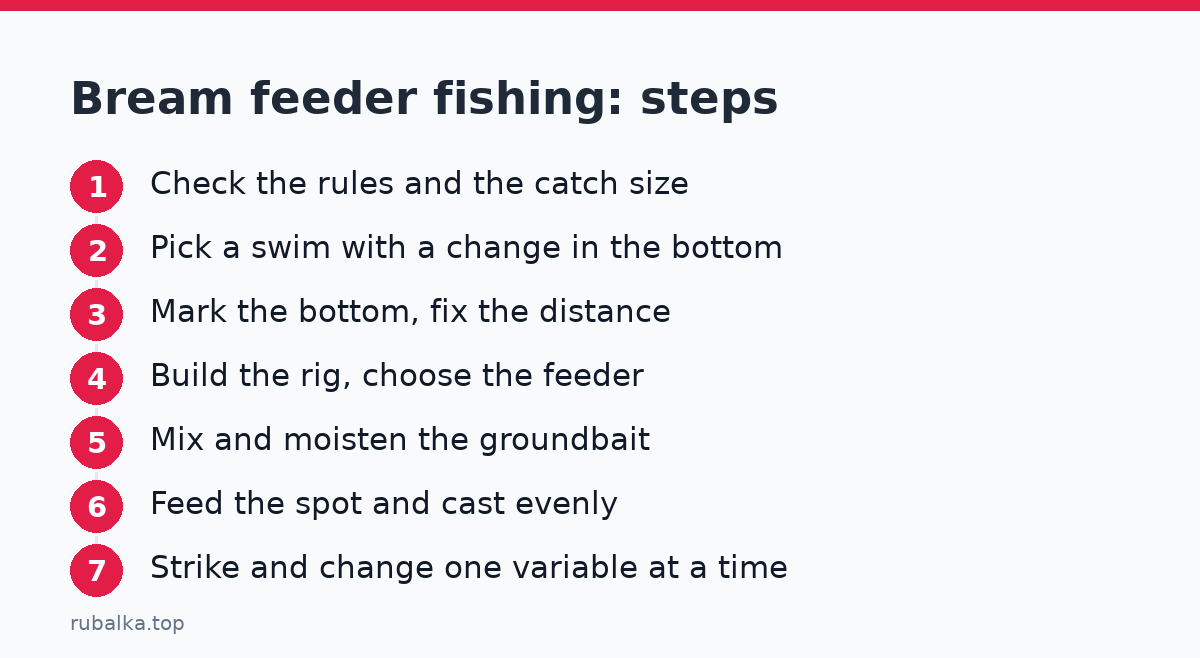
- Find out the rules for the water. Establish the minimum bream size, whether a closed season is in force and what restrictions apply to tackle. Check: you know the figures for your specific water, not “roughly”.
- Choose the type of swim. A drop-off, gully, washout, stone-and-gravel bottom or shell bed; in summer also warm shallows near vegetation. Check: the area has a change in depth or bottom structure, not a flat “plate”.
- Mark the bottom and fix the distance. Measure the depth, find the drop-off, set the line in the line clip and pick a landmark on the bank. Check: two casts in a row land in the same spot.
- Build the rig and pick the feeder. The weight depends on the current and the distance. Check: after the cast the feeder stays put, and the tip does not keep bending from drift.
- Mix and moisten the groundbait. Let it rest, then check the consistency. Check: it binds loosely in your palm and breaks up in the water instead of staying a “rock”.
- Lay down the starting feed. The amount depends on the water; see the groundbait section. Check: every cast goes into the same sector, set by the clip and the landmark.
- Fish with hookbait and keep a recasting rhythm. Do not change everything at once. Check: if there are no bites after several recasts, change one variable: the hookbait, the hooklength or the feeder weight.
- Strike, measure, adjust. Measure keepable fish according to the rules and release small ones. Check: the size and frequency of bites tell you what to change: the hookbait, the mix density or the swim.
How to choose a bream swim: pond, river, reservoir
Bream stay where there is food and quiet depth, so look not just for a “deep spot” but for a change in depth. That means a drop-off, an underwater gully, a washout or an area with a stone-and-gravel bottom. On a reservoir, shell beds are an extra marker: such a spot works as a natural feeding station.

Scouting the bottom and holding the spot
A marker float helps you measure the depth and find drop-offs, and a fish finder does it faster, especially from a boat. For how they work and how to choose one, read the article on fish finders for fishing. After scouting, fix the distance: cast, wind in to tension, set the line in the clip on the reel spool and find a landmark on the far bank.
Set the clip on the scouting cast, not on the first working cast. That way all the groundbait lands in a pile instead of scattering over the bottom.
Season and depth
In summer, big bream are sought in sun-warmed shallows near the water’s edge and shoreline vegetation, where the depth is usually up to 1 m. Advice on seasonal depths differs between sources, so check both the shallows and the drop-off next to them. In autumn bream stay deeper: on drop-offs with current, at 7–12 m, near gullies and washouts with a stone-and-gravel bottom. In the channel runs of the Desna and the Dnipro (4–7 m), heavy, well-moistened groundbait holds well.
Wind and current
On a pond with no current, groundbait stays put and washes out slowly. On a reservoir it is pushed by wind drift, so check from time to time that the feeder and groundbait are in your sector and move the spot if needed. On large rivers like the Dnipro or the Desna, groundbait washes out quickly, so it is cast several times in a row. For a narrow stretch of river, a short feeder rod of about 3 m is handy.
Bream groundbait: mix by current and water temperature
For bream, groundbait should be fine (a thin cloud of particles attracts fish from a distance) and dark: brown or black. It is worth considering how it behaves on your water, because that determines the mix density and how often you recast.
Basic summer recipe for a river
An example for river bream in summer: 1 kg of ready-made bream mix, 0.5 kg of ground dark breadcrumbs, 0.5 kg of cornmeal and small bloodworm or maggots. The starting feed is 8–12 balls the size of a tangerine, then top up every 3–4 casts. The ready-made mix gives a stable base, while the breadcrumbs and meal adjust the colour, the dust and the “lightness” of the cloud.
For a reservoir in autumn, using September as an example, you need heavy, well-moistened groundbait that does not dust. The starting feed is about 5 large feeders, then recast every 15–20 minutes.
| Water | How the groundbait behaves | What follows from this |
|---|---|---|
| Pond without current | Stays put and washes out slowly | No need to top up the spot too often; watch whether the fish lose interest |
| Reservoir | Wind drift carries it away | Heavy, moistened, non-dusting mix; regular recasts; keep checking the position of the spot |
| River with current | Washes out of the feeder and off the bottom | Closed feeder or cage; top up every 3–4 casts; a mix that is not too dusty |
| Channel run of the Dnipro or Desna | Washes out quickly | Several casts in a row, heavy moistened mix |
Water temperature
The recipes above are summer ones. When the water is colder, fish are usually less active, so it makes sense to start with smaller portions and a more restrained smell, adding animal components (bloodworm, maggots). Warm water, on the contrary, allows a more complex mix and more plant-based ingredients. This is a general principle, not a hard rule: test it on the water, and for working with temperature data read the article on the role of water temperature in fishing.
Before fishing, make a test ball: squeeze it in your palm and toss it. If it falls apart in the air, add water; if it does not break up in the water, the mix is too big and too dense.
Bream feeder rig: rod, mainline, hooklength, feeder
The classic rigs for bream are the paternoster and the asymmetric loop. For sensitivity on a reservoir, the paternoster is recommended. An in-line rig exists too, but the sources this article relies on put the emphasis on the first two options. The feeder is attached on an extra length of line above the loop.
| Parameter | River | Reservoir |
|---|---|---|
| Mainline | Braid 0.10–0.14 mm | Mono 0.25–0.28 mm: absorbs the fish’s lunges |
| Feeder | Closed or cage, 60–100 g, capacity 40–60 ml | 30–60 g |
| Rig | Paternoster or asymmetric loop | Paternoster as the sensitive option |
| Hooklength | Fluorocarbon 0.14–0.18 mm, length 40–80 cm | The same |
For a long cast in the channel of the Desna or the Dnipro, anglers recommend 0.12 mm braided line, a size 10–12 hook and bulky hookbaits. For a pond, our sources give no specific figures. Choose the feeder weight by casting distance and depth, with the same principle: it should settle in place, not drift along the bottom.
Do not pick the 40–80 cm hooklength once and for all. Start from the middle of the range and adjust to the result: if the fish bite cautiously and drop the hookbait, change the length or the diameter. For more on choosing line and a reel for feeder fishing, see the articles on fishing line and on the feeder reel. If you are torn between feeder and spinning, there is a comparison, “Spinning vs. Feeder”.
Of the hookbaits, bream most often take maggots, bloodworm, sweetcorn and pearl barley. Start with the one that is also in the groundbait, and in the channel try bulky hookbaits. If two or three recasts bring no bites, change the hookbait, not the weight and the hooklength at the same time.
Common mistakes when loading the feeder
Most failed trips are explained not by “fish that won’t bite” but by a badly loaded feeder and uneven casts. Here is what to check first.
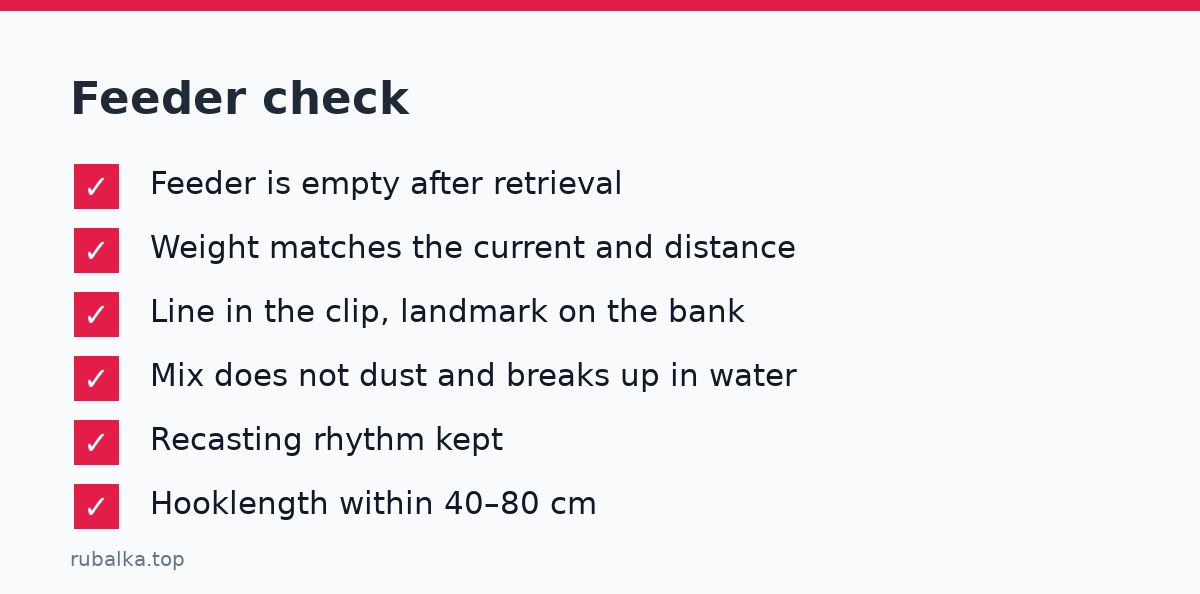
- Packing too tight. After you reel in, the feeder should be almost empty. If it is full or half full, the groundbait did not release on the bottom: make the mix wetter or squeeze it less.
- Mix too loose. If the groundbait washes out on the way down and the feeder is empty on retrieval, the mix is not dense enough for the current. Add a dry base or a heavier component.
- Wrong feeder weight. On a current, aim for 60–100 g, on a reservoir 30–60 g. If the current drags the feeder, move to a heavier one rather than a longer line.
- Overfeeding. A large amount of feed in one spot can fill the fish up. Especially on a pond, where groundbait washes out slowly, top up moderately.
- Irregular recasting. On a river, top up every 3–4 casts, on a reservoir, following the September tactic, every 15–20 minutes. Without a rhythm the spot “fades”.
- Different casting distances. Without a clip, the groundbait scatters across the bottom in a wide circle, and the fish sit at the edge of the sector. Use the clip and a landmark.
- Late strike. Bream bite cautiously: do not strike at the first light movement of the tip, wait for a steady pull.
Bream fishing rules: size, spawning and limits
Under the new Fishing Rules, the minimum size of bream is 35 cm in the Dnipro reservoirs and 30 cm in other inland waters. Earlier the figure was 32 cm; details are in the State Fisheries Agency announcement on the Cabinet of Ministers website. The changes to the rules came into force on January 30, 2024; for their content, including how fish are measured, see the State Fisheries Agency article. Check the current version before you go, because the limits have changed.
The spawning closed season on most fishery waters begins on April 1 and brings strict restrictions on tackle and fishing methods. According to the State Fisheries Agency, during this period a daily limit of 3 kg plus one fish larger than the minimum permitted size applies. More in the article on the spawning ban.
This 3 kg plus one fish is the limit for the spawning period specifically, not a universal figure for the whole year. Outside the closed season and on different waters, conditions may differ, so check them against the current rules and local restrictions.
You may keep a fish of legal size, and release small ones and very large ones if you wish: handle the fish carefully and do not keep it out of the water for long. If the hook is swallowed deep, it is safer for the fish to remove it with a disgorger rather than snap the hooklength.
The summary for your trip: choose a change in the bottom, mark and fix the distance, match the feeder weight to the current and the mix to the water. Cast evenly, recast to a rhythm and change only one variable at a time. It is worth checking the fishing rules at home.
FAQ
What is the minimum size of bream you can keep?
Under the new Fishing Rules, 35 cm in the Dnipro reservoirs and 30 cm in other inland waters. The older version mentioned 32 cm, so check the current version of the rules before you go.
Which is better for bream: ready-made or homemade groundbait?
A practical option is to combine them: a ready-made bream mix as the base plus crushed dark breadcrumbs and cornmeal. The groundbait should be fine and dark, and you adjust the share of homemade additives for the dust and the weight your water needs.
Why won't the bream bite even though I've cast groundbait?
Check whether the feeder empties on the bottom and lies in your sector, and that the current or wind is not dragging it. Then change one variable: the hookbait, the hooklength or the feeder weight. If the spot has no change in the bottom, move to a drop-off or gully.
Is feeder fishing for bream suitable for a pond?
Yes, but on a pond without current groundbait stays put and washes out slowly, so top it up moderately. The sources give no specific feeder weights or line thickness for ponds: choose by casting distance and depth.


Leave a Comment
Your email address will not be published. Required fields are marked *